
CDQ Boiler Refractory Selection Guide: Adapting to Cyclic Rapid Cooling Conditions for Over 10 Years of Long Service Life
Why Refractory Selection Matters for CDQ Boilers
Coke Dry Quenching is an important energy-saving and waste-heat recovery system in modern coking production. Red coke discharged from the coke oven is cooled by circulating inert gas, and its sensible heat is recovered to generate steam. This process improves energy efficiency and reduces the vapor and dust emissions associated with traditional wet quenching.
However, the internal environment of a CDQ boiler is complex. The refractory lining is exposed to high-temperature coke, coke dust, circulating flue gas, and frequent temperature changes. Therefore, refractory materials must provide strong abrasion resistance, thermal shock resistance, chemical resistance, low creep, and high-temperature structural stability.
If refractory selection is not properly matched to operating conditions, problems such as wall wear, inclined flue cracking, corbel deformation, and flue lining erosion may occur. These issues can reduce heat transfer efficiency and shorten continuous operation time.
For this reason, CDQ boiler refractory selection should not rely on a single general-purpose material. A zoned design based on the actual conditions of each area is essential for long-term stable operation.
Main Operating Conditions of CDQ Boilers
Different zones inside a CDQ boiler experience different damage mechanisms. Refractory selection should be based on the specific service conditions of each zone.
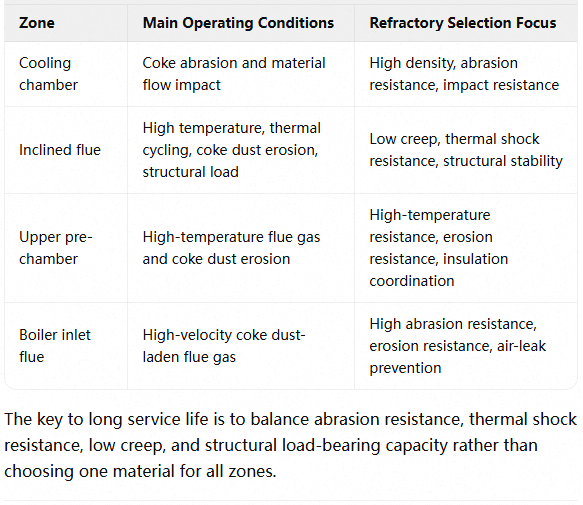
The key to long service life is to balance abrasion resistance, thermal shock resistance, low creep, and structural load-bearing capacity rather than choosing one material for all zones.
Cooling Chamber: Focus on Abrasion and Impact Resistance
The cooling chamber is the zone where high-temperature coke directly contacts the furnace wall. As coke moves downward, it continuously rubs and impacts the lining. If the refractory material has insufficient abrasion resistance, the inner wall may become uneven, worn, or locally hollowed after a period of operation.
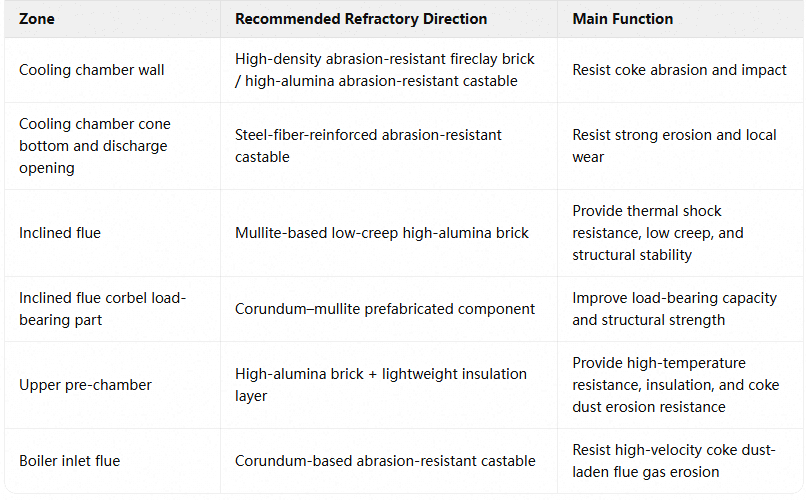
For the cooling chamber wall, high-density abrasion-resistant fireclay bricks or high-alumina abrasion-resistant castables are recommended. Selection should focus on cold crushing strength, abrasion resistance, and impact resistance. For areas with strong coke flow impact, steel-fiber-reinforced abrasion-resistant castables can be used to improve resistance to erosion and mechanical impact.
Cooling chamber selection points:
- Use high-density abrasion-resistant materials for furnace walls.
- Strengthen abrasion-resistant design at conical bottoms and discharge openings.
- Avoid ordinary low-strength fireclay bricks.
- Maintain a smooth inner lining to reduce coke flow resistance.
Inclined Flue: Focus on Thermal Shock, Creep, and Load-Bearing Capacity
The inclined flue is one of the most severe service zones in a CDQ boiler. It is exposed to high-temperature circulating gas, coke dust erosion, frequent temperature fluctuations, and structural loading. In many CDQ boilers, cracking, spalling, and deformation in the inclined flue after several years of operation are often related to insufficient thermal shock resistance, high creep, or weak load-bearing capacity.
For the inclined flue, mullite-based low-creep high-alumina bricks should be prioritized. These materials offer better volume stability and creep resistance at high temperatures, making them suitable for frequent thermal cycling.
For load-bearing parts such as corbels, corundum–mullite prefabricated components are recommended. These components provide high overall strength and structural stability, reducing the risk of cracking, deformation, and fracture under high-temperature load conditions.
Inclined flue selection points:
- Low creep performance is essential.
- Thermal shock resistance must be considered.
- Load-bearing areas require high-strength structural materials.
- Ordinary high-alumina bricks with high creep tendency should be avoided.
Pre-Chamber and Boiler Inlet Flue Refractory Selection
The upper part of the pre-chamber operates at high temperatures and is mainly affected by high-temperature flue gas and coke dust erosion. High-alumina bricks combined with a lightweight insulation layer can meet high-temperature and erosion resistance requirements while helping to reduce heat loss.
The boiler inlet flue is exposed to high-velocity circulating flue gas containing coke dust. Abrasion in this zone is usually severe. Corundum-based abrasion-resistant castables are recommended to improve flue lining durability, extend service life, and reduce the risk of air leakage and frequent repairs.
Pre-chamber and flue selection points:
- The upper pre-chamber should balance high-temperature resistance and insulation.
- The flue lining should focus on abrasion and erosion resistance.
- Castable installation should ensure density and structural integrity.
- Materials with insufficient abrasion resistance should not be used in high-velocity erosion zones.
CDQ Boiler Refractory Selection Reference Table
Key Refractory Selection Mistakes to Avoid
One of the most common mistakes in CDQ boiler refractory selection is using ordinary high-alumina bricks in severe service zones such as the inclined flue. Although ordinary high-alumina bricks have acceptable high-temperature performance, they may suffer from creep deformation, cracking, and spalling under long-term high-temperature loading, rapid temperature changes, and coke dust erosion.
The inclined flue should not rely on ordinary high-alumina bricks. Low-creep mullite-based high-alumina bricks should be prioritized. For load-bearing and structurally sensitive areas, high-strength prefabricated components or dedicated structural materials should be used to avoid deformation, blockage, and safety risks during operation.
Selection principles:
- For the inclined flue, focus on low creep and thermal shock resistance.
- For the cooling chamber, focus on abrasion and impact resistance.
- For the flue, focus on high-velocity erosion resistance.
- For load-bearing areas, high-temperature structural strength is as important as refractoriness.
Application Case: Stable Operation After Inclined Flue Refractory Upgrade
A large coking enterprise in Shanxi operated a 150 t/h CDQ unit where the inclined flue refractory developed large-area cracking after about 4 years of service. This affected heat transfer efficiency and continuous operation stability.
Henan Songrui New Refractories Co., Ltd. optimized the inclined flue refractory solution based on the actual operating conditions of the unit. The upgraded design mainly adopted low-creep mullite-based high-alumina bricks, combined with corresponding structural reinforcement measures. After the upgrade, the inclined flue lining remained structurally intact, with no obvious deformation or blockage. Heat transfer efficiency remained stable, and the plant achieved more than RMB 3 million in additional annual economic benefits through stable steam recovery.
This case shows that when refractory selection matches the actual operating conditions, and when installation and maintenance are properly controlled, long-term stable operation of the CDQ boiler is achievable.
Customer Feedback
“The inclined flue cracking problem used to affect our CDQ boiler operation and maintenance schedule. After adopting the optimized refractory solution from Henan Songrui New Refractories Co., Ltd., the structural stability of the inclined flue improved significantly, the operation cycle was extended, and heat transfer efficiency became more stable.”
“Coke abrasion in the cooling chamber and flue has always been a maintenance challenge. The abrasion-resistant refractory solution provided by Henan Songrui New Refractories Co., Ltd. was well matched to our operating conditions. After implementation, wear was clearly reduced, and shutdown losses caused by frequent repairs were lowered.”
FAQ
Q1: Can a CDQ boiler reach 15 years of service life?
If refractory selection is properly matched to key zones such as the inclined flue, cooling chamber, and flue, and if operation, heating control, and maintenance are standardized, modern large CDQ boilers can be designed and operated to achieve more than 15 years of service life.
Q2: How can fast wear in the CDQ flue be solved?
The boiler inlet flue is exposed to high-velocity coke dust-laden flue gas. Corundum-based abrasion-resistant castables are recommended for the flue lining to improve erosion resistance and extend service life.
Q3: What is the typical refractory overhaul cycle for a CDQ boiler?
With high-quality refractory materials and standardized operation and maintenance, the mid-repair cycle of a CDQ boiler can be extended to 8–10 years. The actual cycle depends on equipment size, operating load, process control, and on-site maintenance conditions.
Q4: Why should ordinary high-alumina bricks not be used in the inclined flue?
The inclined flue is subject to high temperature, rapid temperature changes, coke dust erosion, and structural loading. Ordinary high-alumina bricks may have insufficient creep resistance and thermal shock stability, leading to deformation, cracking, and spalling. Low-creep mullite-based high-alumina bricks are preferred.
Q5: What properties matter most in CDQ boiler refractory selection?
The most important properties are abrasion resistance, thermal shock resistance, low creep, high-temperature structural strength, and resistance to coke dust erosion. Different zones have different service conditions, so a single material should not be used for all areas.
 客服微信 · 17513376789